- Sign In
- |
- Sign Up
- |
- My Quote (0)
- |
- CART (0)

Designed as an economical solution for detecting refrigerants without the limitations posed by solid-state sensor technologies, this R449a-calibrated infrared gas detector module is a replacement and does not come with a mounting base.
Designed as an economical solution for detecting refrigerants without the limitations posed by solid-state sensor technologies, this R449a-calibrated infrared gas detector module is a replacement and does not come with a mounting base.
Advanced infrared sensing technology makes the MGS-250 immune to cross sensitivities from combustible and toxic gases, as well as changes in temperature and humidity. The infrared sensor provides low-level leak detection and delivers up to 5 to 7 years of virtually maintenance-free operation. The MGS-250 has an alpha-numeric LED display, status indicator, on-board relay, and alarm to alert personnel when levels have exceeded the preset limit.
Features
Applications
| Measuring Range | 0 to 3500 ppm |
| Accuracy | Broadband sensors: ±25% Gas-specific sensors: ±5% |
| Resolution | 1 ppm |
| Sensitivity / Minimum Detection Limit | 75 ppm |
| Sensor Channels | 1 |
| Sensor Type | NDIR |
| User Interface | 4-digit, 7-segment red/green LEDs; configuration push buttons |
| Wiring | 1 A at 24 V DC; 0.25 A at 240 V AC, resistive load |
| Analog Communication | 4–20 mA; 0–5 V; 0–10 V; 1–5 V; 2–10 V |
| Digital Communications | Modbus RTU via RS-485 |
| Enclosure Rating | General purpose |
| Expected Sensor Service Life | 5 years |
| Buzzer Volume | 80 dB at 10 cm |
| Alarm | Integrated audible and visual alarm |
| Relay Rating | 1 alarm relay, SPDT |
| Power | 24 V DC ±20% or 24 V AC ±20%, 2.5 W |
| Approvals / Standards | CE, UL, CSA, IEC, EN 61010-1 |
| Altitude | 0 to 6560 ft (2000 m) |
| Ambient Temperature | -22 to 104°F (-30 to 40°C) |
| Operating Voltage | 24 V DC or 24 V AC |
| Humidity | 5 to 90% RH, non-condensing |
| Dimensions | 4 x 5.5 x 1.5" (100 x 140 x 40 mm) |
| Weight | 6.3 oz (180 g) |
by Matthew Eversole
Being responsible for the installation and upkeep of a reliable gas monitoring system in any facility is an important task, and one that should not be taken lightly. Industrial, commercial and public sector buildings all produce and consume a certain amount of toxic gases in the general running of their operations. For example, the HVAC-R systems used to keep buildings at ambient temperatures or chill cold storage rooms and circulate fresh air can leak refrigerant. Additionally, one can find various gases in heavy duty industrial cleaning equipment and as the byproduct of manufacturing processes in production facilities.

Installing gas detectors for safety compliance
Given enough time, despite your best efforts, every refrigeration system will leak. The only way to effectively deal with leaks is to be able to react quickly when they occur.
The first step in preparing for a potential gas leak is to have a network of properly installed and well maintained gas detection units in place throughout your building. Following these simple guidelines will ensure that your facility's gas monitoring system effectively detects the presence of a target gas.
When choosing how many sensors to install, one should always err on the side of caution and get as many units as are required to provide maximum coverage.
Because gas monitors patrol a fixed point, not a general area, you will need to ensure any space which may be directly exposed to gas is monitored. The purpose of detector is negated if the refrigerant leak bypasses the detection point.
While there are no legal guidelines on how many gas monitors one should install, gas detectors should be installed no more than 16.5 feet (5m) from a potential leak source. (Exhaust fans, air returns, etc. are an exception to this guideline.)
In order for a gas detector to effectively serve its purpose, it must be installed where it can be seen, heard, and detect a potential leak. Installers should be mount monitors according to the product dimensions, maximum wiring lengths and the following considerations:
Environmental conditions
Installers should account for the full range of environmental conditions when selecting a location to mount a gas detector.
Avoid adverse conditions
Gas detectors should not be installed in locations where they will be subjected to elements (extreme temperatures, high humidity, high concentration of airborne particles) which are outside of the device's specifications. It is important that the instrument's Ingress Protection (IP) rating is sufficient to protect its sensitive electronics.
Account for currents / airflow
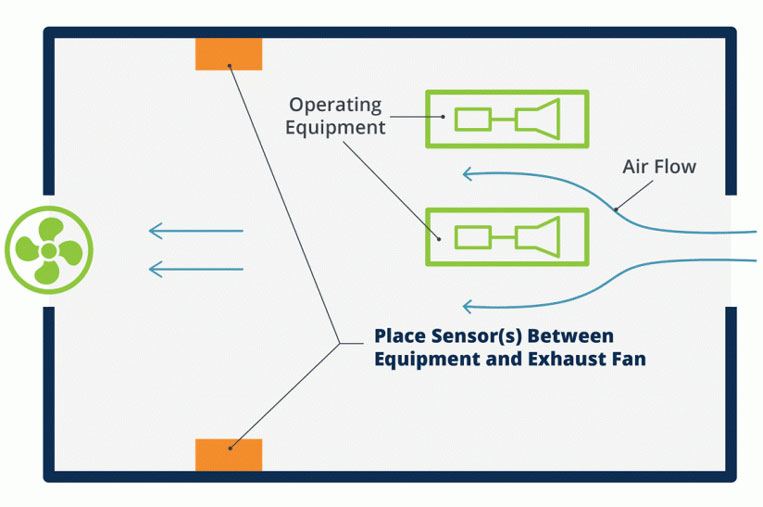
Additionally, installers should take into account the airflow in the monitored space. Room ventilation can alter the airflow pattern and affect how efficiently the gas is monitored. In other words, installers should consider how escaping gas may behave due to air currents. (If appropriate, an installer may choose to mount gas detectors in ventilation ducts.) A smoke test may be conducted to ensure optimal placement.
High airflow may dilute the target gas. Because of this, placing sensors closer to a potential leak source may improve leak detection in spaces with high airflow.
Never locate a refrigerant detector where airflow may become obstructed. This commonly occurs in walk-in freezers where personnel may (inadvertently) push boxes against the instrument. Obstructed airflow to the sensor will result in ineffective leak detection.
Specifics of the application
Installers may chose between perimeter detection and point detection when positioning gas sensors in a monitored space.
Point detection
Point detection involves mounting the gas detectors at specific points where refrigerant leaks may occur. For example, installers may choose to position gas detectors close to compressors, expansion valves, mechanical joints or along cable duct trenches. As a result, leak detectors are located where they can expect to encounter the highest concentration of the target gas.

Perimeter detection
Perimeter detection involves placing gas detection units all around the perimeter of the monitored area. This may be a better option where it is difficult to locate sensors near the leak source. The drawback of perimeter detection is that the target gas may become diluted before it reaches the gas detector.

Accessibility to personnel
Gas detectors require regular maintenance to ensure functionality. Where possible, they should be installed in an area that is easily accessible for functional testing and servicing.
Instruments featuring a remote sensor(s) allow installers to monitor for refrigerant leaks in inaccessible locations without forfeiting convenient access for electrical / communications wiring.
Physical characteristics of the target gas
One also needs to consider the heaviness or lightness (specific gravity) of the target gas. Place sensors used to detect gases heavier than air – such as butane, propane, LPG or ozone – close to ground level. Gas detectors meant to detect the presence of gases that are lighter than air – such as hydrogen, methane, and ammonia – should have monitors located closer to the ceiling. Equal density gases should have monitors mounted at head height (usually 4 – 6 feet from the ground).
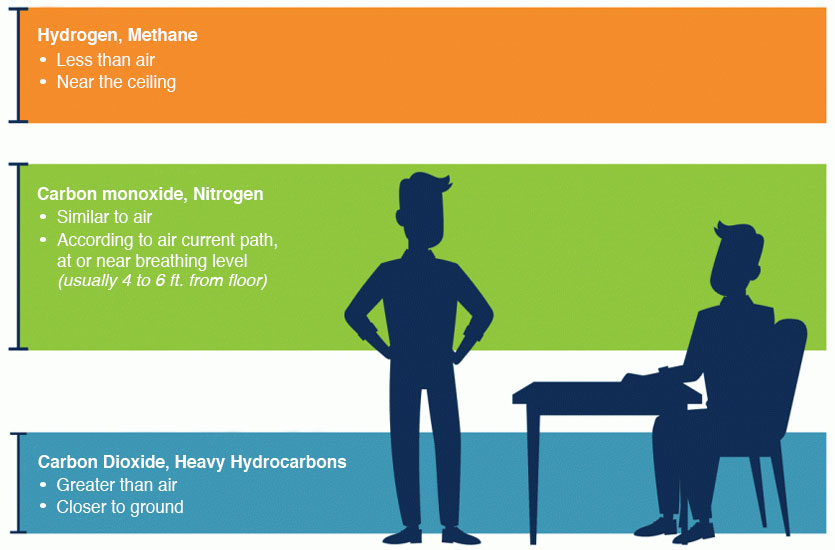
Hydrogen, Methane
Carbon monoxide, Nitrogen
Carbon Dioxide, Heavy Hydrocarbons
The health and safety of your personnel, the general public and the surrounding environment is largely dependent on the safe usage, storage and disposal of hazardous substances and materials. To ensure this safety, gases that are the by-product of building operations or processes (such as HVAC systems and industrial manufacturing, storage and cleaning processes) need to be monitored at all times.
| Measuring Range | 0 to 3500 ppm |
| Accuracy | Broadband sensors: ±25% Gas-specific sensors: ±5% |
| Resolution | 1 ppm |
| Sensitivity / Minimum Detection Limit | 75 ppm |
| Sensor Channels | 1 |
| Sensor Type | NDIR |
| User Interface | 4-digit, 7-segment red/green LEDs; configuration push buttons |
| Wiring | 1 A at 24 V DC; 0.25 A at 240 V AC, resistive load |
| Analog Communication | 4–20 mA; 0–5 V; 0–10 V; 1–5 V; 2–10 V |
| Digital Communications | Modbus RTU via RS-485 |
| Enclosure Rating | General purpose |
| Expected Sensor Service Life | 5 years |
| Buzzer Volume | 80 dB at 10 cm |
| Alarm | Integrated audible and visual alarm |
| Relay Rating | 1 alarm relay, SPDT |
| Power | 24 V DC ±20% or 24 V AC ±20%, 2.5 W |
| Approvals / Standards | CE, UL, CSA, IEC, EN 61010-1 |
| Altitude | 0 to 6560 ft (2000 m) |
| Ambient Temperature | -22 to 104°F (-30 to 40°C) |
| Operating Voltage | 24 V DC or 24 V AC |
| Humidity | 5 to 90% RH, non-condensing |
| Dimensions | 4 x 5.5 x 1.5" (100 x 140 x 40 mm) |
| Weight | 6.3 oz (180 g) |
by Matthew Eversole
Being responsible for the installation and upkeep of a reliable gas monitoring system in any facility is an important task, and one that should not be taken lightly. Industrial, commercial and public sector buildings all produce and consume a certain amount of toxic gases in the general running of their operations. For example, the HVAC-R systems used to keep buildings at ambient temperatures or chill cold storage rooms and circulate fresh air can leak refrigerant. Additionally, one can find various gases in heavy duty industrial cleaning equipment and as the byproduct of manufacturing processes in production facilities.
Installing gas detectors for safety compliance
Given enough time, despite your best efforts, every refrigeration system will leak. The only way to effectively deal with leaks is to be able to react quickly when they occur.
The first step in preparing for a potential gas leak is to have a network of properly installed and well maintained gas detection units in place throughout your building. Following these simple guidelines will ensure that your facility's gas monitoring system effectively detects the presence of a target gas.
When choosing how many sensors to install, one should always err on the side of caution and get as many units as are required to provide maximum coverage.
Because gas monitors patrol a fixed point, not a general area, you will need to ensure any space which may be directly exposed to gas is monitored. The purpose of detector is negated if the refrigerant leak bypasses the detection point.
While there are no legal guidelines on how many gas monitors one should install, gas detectors should be installed no more than 16.5 feet (5m) from a potential leak source. (Exhaust fans, air returns, etc. are an exception to this guideline.)
In order for a gas detector to effectively serve its purpose, it must be installed where it can be seen, heard, and detect a potential leak. Installers should be mount monitors according to the product dimensions, maximum wiring lengths and the following considerations:
Environmental conditions
Installers should account for the full range of environmental conditions when selecting a location to mount a gas detector.
Avoid adverse conditions
Gas detectors should not be installed in locations where they will be subjected to elements (extreme temperatures, high humidity, high concentration of airborne particles) which are outside of the device's specifications. It is important that the instrument's Ingress Protection (IP) rating is sufficient to protect its sensitive electronics.
Account for currents / airflow
Additionally, installers should take into account the airflow in the monitored space. Room ventilation can alter the airflow pattern and affect how efficiently the gas is monitored. In other words, installers should consider how escaping gas may behave due to air currents. (If appropriate, an installer may choose to mount gas detectors in ventilation ducts.) A smoke test may be conducted to ensure optimal placement.
High airflow may dilute the target gas. Because of this, placing sensors closer to a potential leak source may improve leak detection in spaces with high airflow.
Never locate a refrigerant detector where airflow may become obstructed. This commonly occurs in walk-in freezers where personnel may (inadvertently) push boxes against the instrument. Obstructed airflow to the sensor will result in ineffective leak detection.
Specifics of the application
Installers may chose between perimeter detection and point detection when positioning gas sensors in a monitored space.
Point detection
Point detection involves mounting the gas detectors at specific points where refrigerant leaks may occur. For example, installers may choose to position gas detectors close to compressors, expansion valves, mechanical joints or along cable duct trenches. As a result, leak detectors are located where they can expect to encounter the highest concentration of the target gas.
Perimeter detection
Perimeter detection involves placing gas detection units all around the perimeter of the monitored area. This may be a better option where it is difficult to locate sensors near the leak source. The drawback of perimeter detection is that the target gas may become diluted before it reaches the gas detector.
Accessibility to personnel
Gas detectors require regular maintenance to ensure functionality. Where possible, they should be installed in an area that is easily accessible for functional testing and servicing.
Instruments featuring a remote sensor(s) allow installers to monitor for refrigerant leaks in inaccessible locations without forfeiting convenient access for electrical / communications wiring.
Physical characteristics of the target gas
One also needs to consider the heaviness or lightness (specific gravity) of the target gas. Place sensors used to detect gases heavier than air – such as butane, propane, LPG or ozone – close to ground level. Gas detectors meant to detect the presence of gases that are lighter than air – such as hydrogen, methane, and ammonia – should have monitors located closer to the ceiling. Equal density gases should have monitors mounted at head height (usually 4 – 6 feet from the ground).
Hydrogen, Methane
Carbon monoxide, Nitrogen
Carbon Dioxide, Heavy Hydrocarbons
The health and safety of your personnel, the general public and the surrounding environment is largely dependent on the safe usage, storage and disposal of hazardous substances and materials. To ensure this safety, gases that are the by-product of building operations or processes (such as HVAC systems and industrial manufacturing, storage and cleaning processes) need to be monitored at all times.