- Sign In
- |
- Sign Up
- |
- My Quote (0)
- |
- CART (0)
Do you want to Repair or Modify an Electronic Appliance? Or are you starting a DIY Project that requires Soldering?
Look no further, we will look at the different tools needed to get you started.

You will have to consider the wattage needed for your specific need. Most people, that only need to solder once in a while, can get away with using a simple soldering iron, ranging from 25-50w for small appliances and hobbyist uses. These do not require any station to work and usually can't interchange soldering tips.
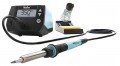
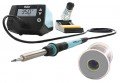
For someone just starting, it is easier to start with a soldering iron station kit that has all the base features so you don't miss anything while working on your project. These usually come with the station, the soldering iron, the safety rest with a cleaning sponge or dry cleaner and sometimes a few extra tips. These kits fit a larger variety of uses and is better suited for frequent users.
* Having higher wattage usually results in shorter heat up times and a more consistent & accurate temperature.
Choose this one depending on the task at hand. Some contain Lead, Flux while others don't, make sure to do some research for the optimal one. Depending on which one you choose, the temperature needed for use will change.
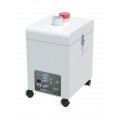
For the safety of the user and those around, it is important to use a smoke absorber or extractor. For smaller project you could get away with using a smaller and more budget friendly benchtop smoke absorber. For industrial or frequent use it is recommended to use a more heavy-duty Solder Fume Extractor to remove smoke more efficiently so the users are less exposed.
Every soldering iron should be used in conjunction with a holder where the soldering iron wand can rest. You can let your wand rest while warming up and while it is hot and not in use.
* If you're not getting a package kit, getting a soldering iron holder is a must as it is very useful and safer for the user.
For safety, it is recommended to wear safety glasses while working with the soldering iron.
You can change the tip to a variety of angles and sizes to fit your task. We listed a few soldering tips for your convenience.
* Preparing your Soldering Iron with tinning the tip can help improve the heat transfer, protect and reduce wear.
If your project is more complex or precise, you may need soldering arms to hold your piece while you work on it. These can come with a light and a magnifier glass.
Wire Strippers can be useful if your project involves working on wires. Use these to strip the wire to get it ready to be soldered to another wire or electronic part. Wire strippers are pretty standard, but make sure your wire size is covered with your selected wire stripper.
When working with a soldering iron mistakes can happen, therefore it is important to have the required tools to fix these mistakes and keep working on your project. You can either desolder with a desoldering unit that is similar to a soldering iron or you can get a "solder sucker" that removes the heated solder with suction.
* It's the user responsability to get the required education and to take all the safety precautions.




This product exceeds standard shipping dimensions/weight, as such it does not qualify for free shipping. We will contact you with your shipping costs.
This product exceeds standard shipping dimensions/weight, as such it does not qualify for free shipping. We will contact you with your shipping costs.